Hearing Tests in La Mesa, CA
Do you know what you are missing?
The truth is, with hearing loss you don’t know. Once your brain stops registering specific sounds, you don’t even know they are there.
If it’s spring, ever wonder why you don’t hear the robin outside your window? They haven’t gone away. It’s just that you can’t hear them anymore, along with a host of other sounds. It’s worth getting your hearing checked to find out what you are missing. Then you can decide if you really want to be tuned in or tuned out.

Why get a hearing test?
The World Health Organization projects that by the year 2050, one in every ten people will have debilitating hearing loss that requires intervention. This is even worse as you get older: One in every 3 people over the age of 65 has hearing loss.
Yet many people are unaware that they have hearing loss. That’s because hearing loss often progresses quite slowly, making any deterioration easy to miss until the damage is irreversible. Hearing tests help track your hearing over time and catch hearing loss early.
After all, hearing loss is a serious issue. If left untreated, it can lead to serious health issues, including cognitive decline. Why risk that when hearing tests are simple and painless?
Hearing tests:
- Catch hearing loss early
- Determine which hearing loss solutions are best for you
- Help you customize and program your hearing aids
How do I know if my hearing is bad, and when should I get tested?
Have you tried this super simple hearing test?
Ask your spouse, your kids, and your friends if they think you should get your hearing tested. Chances are, you don’t even need to ask. They’ve probably been telling you for years to see a specialist and get your hearing tested.
Yes, most of us are more stubborn than mules and have put off acknowledging our hearing loss for years and years. But, whether you’re experiencing symptoms or not, hearing tests are proactive steps you can take to protect your hearing and detect problems early.
The general guidelines for such hearing tests are:
- If you are under 50 and have no signs of hearing loss: You should generally have your hearing tested every 3 years.
- 50 – 65: You should have your hearing tests at least once every two years. One in every four adults who report excellent hearing actually has some hearing loss, so it’s a good idea to get tested even if you aren’t noticing symptoms.
- 65 or older: At this age, more than 30 percent of people have hearing loss. You should get your hearing checked annually.
Experts also recommend that you undergo at least one hearing test after reaching the age of 20 in order to establish a hearing baseline.
The frequency of these hearing tests can and should change if you begin noticing that you’re having hearing problems.
7 telltale signs you need a hearing test
Consider getting a hearing test if you:
- Begin to withdraw from social settings. For example, if you avoid going out with friends or co-workers.
- Have significant fatigue or memory problems, even if you’re getting enough sleep.
- Notice that voices sound muffled or distant when talking to other people.
- Have trouble understanding conversations because it feels as though letters or sounds keep dropping out–especially consonants.
- Need to consistently turn up the volume on your radio, mobile phone, or television.
- Ask others to speak up or repeat themselves frequently.
- Can’t understand speech in a crowd or in noisy situations.
If you suspect you are experiencing the symptoms of hearing loss, it’s important to undergo a hearing test as quickly as possible. The sooner you undergo your hearing test, the faster you will be able to hear better.
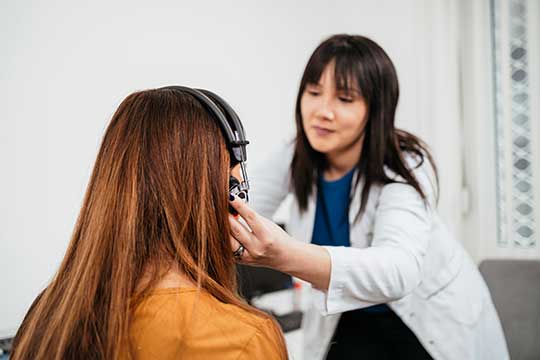
How can I test my hearing?
Every day you wake up is a test, and every day your family or friends talk to you is a test too. And it’d be easy to think everything is fine or almost perfect based on what you are hearing. Of course, the big problem is that there is a good chance you’ve already forgotten what you are missing. That happens to the best of us.
Which is why a professional hearing test is so important. You’ll discover what frequencies and types of sounds have gone missing and options for making them part of your life again, including hearing when your spouse or friend asks you to help with the dishes.
It’s easy to get started. Schedule a hearing test with us in La Mesa to see if hearing aids will improve your ability to hear.
Our hearing test will check your ability to hear different frequencies. Most people will lose the ability to hear very low or high frequency sounds before there is any noticeable deterioration of the ability to detect mid-frequency noises.
All of this information is then displayed on an easy-to-read graph, called an audiogram. Effectively addressing your hearing loss depends on the ability to amplify the wavelengths you have difficulty hearing, making an audiogram an indispensable first step.
Types of hearing tests in La Mesa, CA
There are many ways to test your hearing, including:
Pure-tone audiometry
During this test, your hearing specialist will instruct you to listen to tones at different frequencies and volumes.
Speech audiometry
Instead of listening to notes, you’ll listen to audible speech in a quiet room, in order to determine the lowest level you can hear a word and still understand it. Word recognition testing is a specific component of speech audiometry that focuses on the individual’s ability to accurately identify spoken words.
What’s Included in Your Hearing Evaluation at Best Ears Ahead
A professional hearing evaluation isn’t just one test — it’s a series of targeted assessments, chosen based on your age, symptoms, and health history.
Here’s what you can expect:
Pure-Tone Audiometry
You’ll listen to tones at different pitches and volumes through headphones and signal when you can hear them. This maps out the quietest sounds you can detect across the full frequency range.
Bone Conduction
Testing A small device placed behind the ear sends vibrations directly to your inner ear, bypassing the ear canal entirely. This tells us whether hearing loss is originating in the outer/middle ear (conductive) or in the inner ear and auditory nerve (sensorineural) — a critical distinction for determining the right treatment.
Speech Testing
Rather than tones, you’ll listen to words and phrases at varying volumes. This reveals how clearly you can understand speech at the edge of your hearing range — because being able to detect sound and actually understand conversation are two different things.
Otoscopy & Middle Ear Assessment (as needed)
We may perform a visual inspection of your ear canal and eardrum, as well as tympanometry — a quick, painless test of how well your middle ear is functioning. This rules out blockages, fluid, or structural issues that may be contributing to your hearing difficulties.
Your full evaluation typically takes 45–60 minutes, including time to review your results and ask questions.
What Happens After Your Hearing Test
Getting your results is just the beginning — here’s what comes next.
Step 1: You’ll review your audiogram together Your results are plotted on a graph called an audiogram, which we’ll walk through with you in plain language. We’ll explain what frequencies you hear well, where any gaps exist, and what that means for your day-to-day life. No medical jargon, no guesswork — just a clear picture of your hearing health.
Step 2: We’ll talk through your options If your results show hearing loss, we’ll explain exactly what type it is and what solutions are available. That might be hearing aids, hearing protection, a referral to a physician, or simply a monitoring plan if your hearing is still within normal limits. There’s no pressure to make a decision on the spot.
Step 3: If hearing aids are right for you, we’ll fit them properly Not all hearing losses are the same, which means not all hearing aids are either. We’ll match you to a solution based on your specific audiogram, your lifestyle, and your budget — then make sure they’re programmed and fitted correctly from day one.
And if your hearing is fine? Great news — you’ll leave with a baseline on file, so any future changes are easy to track.
We accept most major insurance plans and offer financing options. Call us to verify your coverage before your appointment.