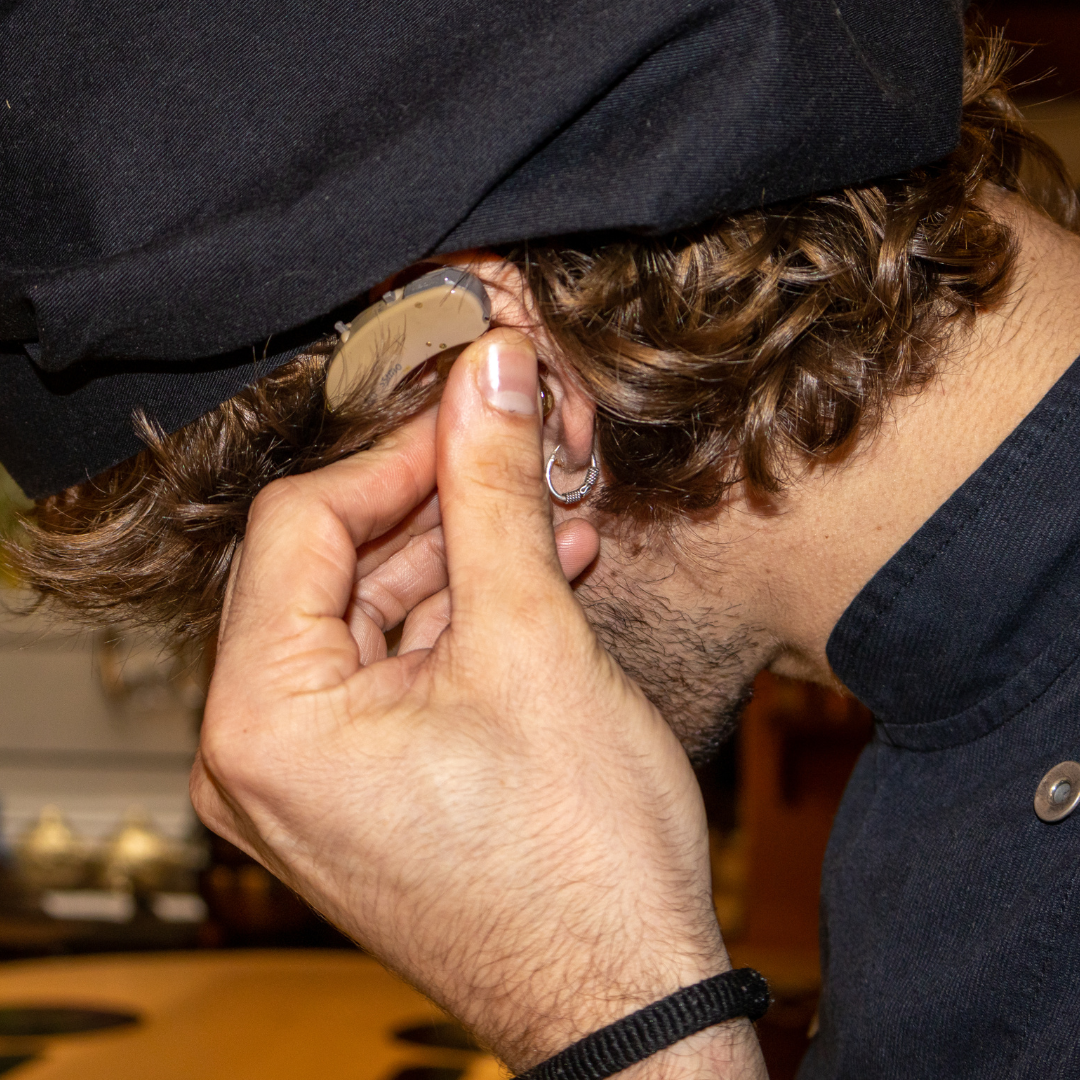
Tracking speech in busy dining venues can feel exhausting when environmental noise drowns out your hearing. Our clinical team can evaluate hearing across quiet settings and background-noise environments to pinpoint specific auditory challenges. Once the diagnostic etiology of your difficult hearing is established, we implement personalized clinical and technological strategies.
Why Do I Hear Well in Quiet but Struggle in Restaurants?
A tranquil environment produces a beneficial signal-to-noise ratio where spoken dialogue easily overpowers weak ambient noise. Modern restaurant environments create the complete opposite listening environment. Overlapping chatter, piped music, kitchen clatter, and hard-surface reverberation mask speech, forcing the brain to expend immense cognitive effort to track conversation.
These auditory struggles commonly accompany untreated high-frequency hearing loss, central processing delays, or presbycusis. Attention, fatigue, dim lighting, and distance from the speaker may make it worse. Certain patients demonstrate normal sensitivity on routine audiograms while struggling significantly during advanced speech-in-noise testing. Experiencing speech-recognition struggles in noisy dining venues warrants a formal audiological evaluation regardless of seemingly normal quiet hearing.
Diagnostic Protocols for High-Frequency Hearing Loss
Diagnostic assessment begins by documenting specific listening breakdowns, recreational noise exposure, tinnitus symptoms, medications, and hereditary auditory patterns.
Through pure-tone audiometry, we determine your faintest auditory perception across low to high pitches utilizing both air and bone conduction testing. In high-frequency hearing loss, the audiogram reveals a sloping configuration where hearing acuity drops progressively as pitch frequencies increase. Additional testing may include tympanometry to assess middle-ear function and word-recognition testing to measure speech understanding.
A quiet sound booth cannot replicate complex dining room acoustics, which makes clinical speech-in-noise testing especially informative. This diagnostic protocol measures your capacity to understand target words or sentences against progressively louder multi-talker babble. In combination, these diagnostic metrics reveal whether communication hurdles involve audibility thresholds, speech discrimination, neural noise management, or mixed conditions.
How Auditory Processing Difficulties Impact Adult Hearing
An auditory processing disorder degrades the central nervous system’s capacity to organize and interpret complex sound inputs. A patient’s ears may demonstrate normal pure-tone sensitivity, but their central processing system struggles to separate background babble, distinguish consonant sounds, or follow swift discussions. We prioritize assessing peripheral auditory acuity before recommending an in-depth central auditory-processing assessment or external medical referrals.
How to Improve Speech Clarity in Challenging Acoustic Environments
Strategic behavioral modifications can substantially improve the auditory signal reaching your ears while maximizing supportive visual cues. Before leaving home, identify quieter dining venues or plan to eat during less crowded service times. Restaurants featuring plush booths, wall acoustic panels, heavy drapery, carpeting, and sound-dampening materials provide superior listening compared to open rooms with reflective surfaces.
When arriving at the dining venue:
- Select a secluded table situated away from prep kitchens, crowded bar stations, loudspeaker zones, and large parties.
- Position your chair against a perimeter wall to diminish competing auditory chatter behind your head.
- Face your conversation partners in good lighting.
- Reduce physical spacing between yourself and companions to maximize direct speech perception.
- Position your better-hearing ear directly toward your main conversational partner.
- Request that companions rephrase misunderstandings using different words rather than repeating the same sentence.
- Explicitly repeat back important logistical details instead of pretending you caught every word.
- Excuse yourself for a momentary quiet pause when listening exhaustion starts to mount.
- Ask companions to speak clearly at a natural pace.
- Elevated yelling distorts auditory signals and seldom improves actual phonetic comprehension.
Assistive Hearing Tools and Technology for Complex Acoustic Environments
Choosing the most effective auditory device requires evaluating diagnostic findings, acoustic lifestyle factors, and the presence of hearing loss. Professionally fitted hearing aids may use directional microphones, digital noise reduction, and dedicated restaurant programs to emphasize speech from the front and reduce some competing sound. However, users must maintain realistic expectations, as no clinical technology can eliminate every competing background speaker entirely.
A remote microphone can provide a stronger improvement in the signal-to-noise ratio. Positioned near or clipped to the speaker, the device transmits raw speech audio directly to paired hearing aids or external listening receivers. This reduces the effects of distance and surrounding noise.
Further practical hearing technology options include:
- Dedicated table microphones engineered to capture small-group dialogue
- Telecoil components connecting directly to public hearing-loop systems
- Mobile phone live-transcription apps offering real-time conversational subtitles
- Modern wireless hearables delivering directional beamforming and sound enhancement
- Sound-level meter applications and community-driven quiet dining guides
We can compare options, confirm compatibility, and teach you how to use the selected device.
Professional Audiological Solutions for Loud Listening Environments
A professional clinical assessment moves beyond basic baseline statements like “I hear fine in quiet rooms.” We analyze the exact social venues, voice registers, and noise environments that cause difficulty to administer tests matching your lifestyle. The assessment may include pure-tone thresholds, middle-ear testing, word recognition, and speech-in-noise measures. Advanced auditory-processing testing can be introduced whenever medical history and baseline assessments justify specialized evaluation.
Any sudden, asymmetric, or rapidly deteriorating hearing loss demands immediate medical evaluation by an ear, nose, and throat physician. Tailored audiological treatment identifies the exact origin of listening breakdown rather than assuming environmental dining noise is the sole culprit.
Book Your Comprehensive Hearing Evaluation Now
If dining in loud spaces leaves you feeling isolated, fatigued, or guessing at missed speech, contact us to schedule a thorough hearing evaluation. We will help you navigate hearing in noisy environments by implementing advanced hearing aid options, assistive accessories, or therapeutic auditory strategies tailored to your lifestyle.
Reach out to our audiology clinic today to schedule an evaluation and begin enjoying clear, effortless conversations.